Northern Plains Archive
Emergency Response Project
* * * * * * * * * *
Contents:
Document Summary
Evolution of the Emergency Response Project
Relevance of the study to the Northern Plains
A quick history of the Northeast Blackouts--1965, 1977, 2003
Risks and Threats--The Grid and Congressional Testimony
Disaster Scenarios--Framing the response
The Disaster Preparation Response Model
The Response Process and Sample Scenarios
The "Get Me Home" Bag and Contents
Future Additions to the Project Report
The NPAP--Briefly
Over the past few years, there has been a rising chorus of voices advising us to have supplies purchased and in place for individual and family preparedness in case of natural or technological disaster or hostile actions against our infrastructure. Now, in addition to the hurricanes, earthquakes, fires and tornadoes that have been the focus of such warnings for most of us, come warnings about the vulnerability of our electrical grid and nuclear facilities. These warnings might be easier to shrug off if those voicing them were not senior Congress people and Assistant Secretaries of Defense.
A little research shows that there appears to be substance to such official information and public announcements. Over the last 40 years, the major blackouts in the Northeast have shown a pattern of increasing areas affected and increasing duration. The most recent, in 2003, lasted three days and affected 55 million people in eight states and Canada. In testimony before Congress in May of 2011, federal officials not only pointed out that the building of a "smart grid" actually increases our vulnerability to hackers and foreign states, but also that there have already been such intrusions.
In September, 2011, while the country was still dealing with the power outages occasioned by Hurricane Irene on the East Coast, a routine repair by a power company employee in Yuma, Arizona, cascaded across the Southwest, knocking out power to as many as six million people in California, Arizona and Mexico, closing down the San Diego airport, taking nuclear reactors off line and causing the spill of 3.2 million gallons of sewage on San Diego beaches.
Federal government websites state that individuals and families should have the things necessary to survive for three to fourteen days on their own. But buying a stack of things without confronting the sometimes scary realities that such an event would bring, while certainly better than doing nothing at all, is not really enough.
This document wargames a scenario for what such an event could mean for a typical family group in a non-disaster-prone area of the upper midwest. It points out that the purchase of a "go bag" on the Internet, without further preparation and planning can provide little besides false security, although, once again, it's probably better than doing nothing.
The time and money put into a comprehensive plan and a system of items needed for response to a disaster may just be the best investment you hope you will never need.
This discussion will help guide you through one such process.
* * * * * * * * * *
BACKGROUND: What's going on with all this talk recently of "go bags?"
It's probably a matter of "critical mass." For quite some time there has been a level of background hum about individual and family preparedness, threats to national security here on the North American continent, cyberwar and natural disasters. That hum has been building, especially over the last couple of years. But so much news (or news-like information) passes in front of us these days, that things get diluted. At the same time, the emphasis was on disaster response, in the event of hurricanes, earthquakes and the like. Up here in the Midwest, it's been right at 200 years since the last earthquake of import (although it was the biggest in US history) and even longer since a hurricane bothered us much. Floods and tornadoes don't have the same kind of dispersion and range.
It also seemed as if there were some things we weren't being told. On the one hand we had color-coded alert statuses, ever-more intrusive airport procedures and equipment, and politicization of the governmental response to impending and actual disaster, from 2005 to the present. On the other hand, there were things like the news footage of a massive yard full of shipping containers coming in from about a zillion overseas ports, stacked high upon one another and an official of some sort saying that only a small percentage could be searched. It looked like the messages about security and preparedness were getting badly scrambled, and we were probably on our own in figuring this thing out. But somehow we never quite seemed to get around to doing much more than thinking about it and shaking our heads.
So, what happened to change that?
For one thing, we finally figured out that with this much "ice" sticking up out of the water, we better assume that there was an iceberg under there somewhere and start taking some steps. When everyone from elected officials to Congressional witnesses to FEMA to the Secretary of Homeland Security to for Pete's sake Mary Hunt (the newspaper columnist on personal finances) lines up on something, it probably makes sense to pay attention. And their message was pretty unanimous: It's a dangerous world out there and everyone should have something called a "Go Bag," a "Bug-Out Bag," a "GOOD (Get Out Of Dodge) Bag" or some other (and quite possibly obscene) variant moniker. When it came down to details though, about what dangers to prepare for and what to get ready, it all got a little ambiguous.
But some of us simply could not get one common set of images out of our heads. They were from the news footage of the evacuation in advance of one of the 2005 or 2006 hurricanes. There was a northbound interstate plugged solid with vehicles and nothing was moving. Nothing had been moving for so long that cars and trucks were running out of gas from running the air conditioning so that the very young, the very old and the very sick didn't have to deal with relative temperatures up around a hundred Fahrenheit at the same time as the fear and anxiety of worrying about what in the world would happen if they got hit with winds over a hundred miles an hour while they were trapped in that traffic jam. All along the interstate were filling stations that had sold totally out of fuel. And in the middle of the whole thing a bus full of refugees (we think it was folks from a nursing home, but...) went rogue and burned to the axles, leaving the passengers standing in the heat on that interstate with what they had in the pockets of whatever they were wearing. One could not help but ponder "What if that was us...me and my wife and my grandkids...?" Think of it as something like a counter-hum...
By late in 2010, we had started doing more research and building a test-bed here at the Archive Project to figure out some answers to those questions of "What are we getting ready for?" and "How do we get ready?" Some of us went with our military training and started doing some threat analysis. The northern plains has a long, and largely unknown history of disasters that came out of nowhere, took a terrible toll of lives and property, and could have been lessened in effect with some preparation, from the Hinkley Fire to the Children's Blizzard. There aren't that many people over 50 up here who don't have some kind of equipment in the trunk of their vehicle during the winter, just in case of a spin-out or a stranding.
Still, everybody kept circling back to the question, "What's a 'Go Bag?' Exactly?"
In March of 2011, we got an additional kick in the pants, from Mary Hunt. She writes a newspaper column and web site about consumer finance and getting the heck out of debt, and on the 7th of March it began, "If there's one lesson we can learn from each disaster we live through or watch on television, it's this: Make sure you're always prepared to grab and go with very little notice. And don't assume you'll get days or even hours' notice. Get ready now. Every household needs a "Go Bag."
A lot of people probably found that one neatly clipped and stuck to the refrigerator door with about fifteen brightly colored magnets.
She went on to list the things that needed to be pre-packed in a family kit (on wheels) and an individual backpack for each member of the household, including tools (like a shovel, etc.), clothing, food, water, first aid supplies and a short list of some of the personal items that needed to be included in the various loads, although it took us a while to notice that toilet paper was not included. To some extent this was follow-up to material she had published on her web site back to August of 2007. A very astute response at that time noted that the reader had actually put a 72-hour bag together and left it by the back door, ready to go. It weighed over 60 pounds all by itself.
We didn't add that all up right away, but she did help us close in on a detailed description of someone's idea of a "Go Bag." We were already following the trail of recommended web sites and organizations. There were some very good private sites, like http://3days3ways.org and others, and a range of government sites set up by FEMA (http://www.fema.gov/areyouready), the Department of Homeland Security (http://www.ready.gov) and (http://www.dhs.gov/files/prepresprecovery.shtm) and others.
And
right about there is where we decided that a "Go Bag" is not a
physical object at all. It's something to direct
our attention. It's a
concept, a "system" if you will. It's all the stuff you would
wish you had if the fertilizer hit the circular air movement device and you
had to take care of your family for three to fourteen days without outside
sources for electricity, water, food, medical supplies, information and
other needs, and also had to be prepared to evacuate them on short notice at some
point during that period. And you
need to design your "system" with scenarios for real-world threats
in mind. OK. But
what kinds of events could require those kinds of "go systems"
outside the zones along the boundaries of the country where hurricanes,
earthquakes and that sort of thing occur? Maybe it's
just us, but wildfires sure seem to be getting bigger and moving faster,
and not just in California. Recent fires in Georgia and Florida (http://www.nasa.gov/mission_pages/fires/main/usa/20110619-gafl.html),
Arizona and New Mexico (http://www.nasa.gov/mission_pages/fires/main/usa/20110706-new-mexico.html),
Colorado (http://www.nasa.gov/mission_pages/fires/main/usa/20110324_indiangulch.html)
and elsewhere and the interviews on the nightly news with folks who had
very short notice to evacuate, argue strongly that a prepared "go
system" should be in place if you live in an area where this could be
a threat. Another example that is very
close to home in the Upper Midwest is the tornado that hit Minneapolis'
North Side on May 22, 2011 (http://minnesota.publicradio.org/display/web/2011/05/22/minneapolis-storm-damage-photos/).
The damage and fatalities that occurred on that same day in Joplin and
elsewhere subsumed this story in the national media, but the visual
evidence of the damage in this approximate four square miles and the
follow-on effects (http://www.startribune.com/local/minneapolis/122807824.html)
argue strongly for the wisdom of having a "go system" in densely
populated urban areas. That argument is not just for people caught in their
homes by the storm who may be forced to evacuate for an extended period,
but also for a system to support someone trying to return to their home and
family in that area, perhaps from work, who may not be able to take
their vehicle into the area because of blocked streets or cordons. The
FEMA website noted above breaks the threats down into
three general categories. These two examples are from the first of those
categories: natural hazards. The second category is technological hazards
including nuclear power plants, which might not have loomed so
large in our rear-view mirror were it not for the on-going events in Japan
after their recent tsunami. FEMA draws 10 and 50-mile circles around
nuclear power plants for risk. The first is for the threat of direct
exposure to radiation. The second is for contamination by radioactive
materials. Once again, in an example for the Upper Midwest, the nuclear
plant at Monticello, Minnesota is less than 30 miles northwest of the Saint
Paul-Minneapolis Metropolitan Area. The Prairie Island nuclear plant is
approximately the same distance from the Metro to the southeast. The
overlap of those two 50-mile circles would cover a huge portion of the more
than three million people in the metro area, and easily cover interstate 35
to the south and interstate 94 to the east. The 10-mile circles would close
travel on I-94 to the north and this does not begin to forecast wind
effects and the resulting downwind plume or plumes of radioactive debris. The
third FEMA category is threats relating to terrorism, and everyone will
have to weigh for themselves what the risks to them are from the kinds of
threat posed by extremists and how they would affect a decision about
whether to assemble the kind of "go system" we've been
discussing. There is another risk
however, which has gained increasing attention in the past few months,
after years of concern which never rose to the same level of public
awareness as some of the things previously discussed. The
power grid. The
ELECTRICAL power grid?? Yep. It's
been a matter of concern for at least 45 years, since the
Northeast Blackout of 1965. That was the "big one" for
power failures for nearly 40 years. There was even a movie and pretty firmly entrenched urban
legend that it was followed, nine months later, by a small population
explosion. What actually happened, in
small part, is that at 5:16 pm on November 9th, an overcurrent relay on a
single transmission line at Niagara Station near the U.S.-Canadian border
tripped, taking the line down. It took 2.5 seconds for five other
transmission lines to overload and go down, isolating the Niagara power
station and causing the generators to become unstable and shut down. It
took another 4 seconds for the grid in the Northeast to break into
separated systems or "islands" and most of these began to black
out within another five minutes, as load imbalances took out connections.
The area covered was most of New York, New England and Ontario and large
areas of Pennsylvania and New Jersey. The lights went out for about 30
million people, for up to 13 hours. Steps
were taken. President Johnson wrote a letter, immediately, to the chairman
of the Federal Power Commission ordering an investigation and report, as
well as the cooperation of the FBI and the Department of Defense. The
report was issued in June of 1967 and the National
Electric Reliability Council, (now the North American Electric Reliability
Council, (NERC)) was formed in June, 1968. It was made up of Regional
Reliability Councils (there are now 10) which set standards, coordinate and
conduct tests on the system. The
actual system itself is apparently called the North American Interconnected
Systems. It consists of four subsystems which are autonomous and
"asynchronous"--connected to one another only by direct current
interconnections. So we had a huge
event, with a huge impact, quick action as these things go, and answers
that are still in place to this day. Not bad, as these thing go, right? And
ten years later,
on July 13th, 1977, at 8:37 in the evening of a hot and air-conditioned
evening in New York City, lightning hit the Buchanan South substation on
the Hudson River and tripped two circuit breakers. They were unable to
reset and restore power flow, due to a loose locking nut and and an upgrade
schedule that had fallen behind. This was followed by a second lightning
strike which took out two transmission lines (only one of which then reset)
and loss of power from the Indian Point nuclear plant. New
York City was not full of happy campers. A severe financial crisis in the
city coincided with anxiety over the Son of Sam murders. Nationwide, things
were not much better, as the country tried to deal with
"stagflation," the lingering effects of the Arab Oil Embargo
following the US support of Israel during the Yom Kippur War of 1973 and of
the stock market crash of 1973 and 1974 (recovery from which would take
until 1993). During the next hour,
there would be another lightning strike, semantic confusion within the
electric utilities of the meaning of the phrase "shed load,"
overloaded (and hence overheated and expanded) transmission lines sagging
and coming into contact
with something (probably vegetation), failed attempts to manually intervene
as the system came down and the overloading of submarine cables between
Long Island and Connecticut. At 9:27 the biggest generator in New York
City, Ravenswood 3, also known as Big Allis, shut down, effectively
blacking out the city. By 9:29 Continental Edison utility began to isolate
itself from the grid outside as protective devices kicked in, and at 9:36
the entire Continental Edison system shut down. In the dark. In the middle
of a heat wave. In a metropolitan area whose television availability was
pretty much reduced to Channel 2 (WCBS) for the next 24+ hours, assuming
there was a way to see it. All
Hell broke loose. Power was not
restored to the entire city until 10:39 on July 14th, over 24 hours after
the cascading events in the power grid led to the blackout. During that
period, there were more than 3,700 arrests, incident to 1,616 stores being
damaged in rioting, looting and arson. 1,037 fires were responded to,
including 14 multiple alarm incidents. Mayor Abe Beame was discomfited,
stating, "We've seen our citizens subjected to violence, vandalism,
theft and discomfort. The Blackout has threatened our safety and has
seriously impacted our economy. We've been needlessly subjected to a night
of terror in many communities that have been wantonly looted and burned.
The costs when finally tallied will be enormous." The
Carter administration kicked in $11 million to help defray the damages from
the Blackout. Abe Beame came in third in the next Democratic primary,
behind Mario Cuomo and Ed Koch (who won the general election). In 1999, the
effects of the blackout were part of Spike Lee's film Summer of Sam,
earlier, there had been episodes of All in the Family and The
Jeffersons based on events during it, and they are probably still
making video games using the landscape during the riots as a theme. There
were investigations and finger-pointing and changes were made to prevent
anything similar, which are still in effect today. There were a lot of
trials, some say hip-hop was born out of the rubble and looting, and the
rest of the country spent a few minutes being grateful that they weren't
among the 10 million folks affected. It
took 12 years for the 1965 Northeast Blackout to be followed by the 1977
New York City Blackout. It was 16
more years until the Blackout of 2003. This
one started after noon on the 14th of August. The early events included a
failure to reset a monitoring device, the failure of the FirstEnergy
generating plant in Eastlake, Ohio, and contact with trees, again by
overloaded transmission lines drooping. By the time it was done it was the
second biggest blackout in history, surpassed only by one in Brazil four
years earlier. This blackout featured something new in events of its kind,
however. Computer failure.
FirstEnergy was running General Electric energy management system software.
Buried deep in the millions of lines of code was a bug called a "race
condition." In practical effect, the reports and alarms that the
FirstEnergy technicians needed to slow or stop the power outages were
running late, so the techs could never catch up. [http://www.securityfocus.com/news/8016] This
one affected 45 million people in eight states in the US, plus another 10
million people in Canada. It lasted about three
days (which sort of makes you wonder...) and showed how vulnerable the
system still was to cascading effects, especially if the monitoring and
control software was a little out of whack. This blackout is well worth a little
research of your own. Backup systems for essential services helped somewhat
in some areas, but many failed. The telephone and wireless systems remained
operational where backup power was available, but circuit overload
drastically reduced the efficiency of these systems. Municipal water
systems in some areas lost pressure, requiring that all water be boiled
before use. There were many other direct and indirect effects. And
all of that was just in a small geographic area of the total grid, albeit
heavily populated. What if the rest of
the Eastern Interconnection went down? We're assuming that
if a Congressman or an Assistant Secretary of Defense, for instance speaks
in alarming terms about "the grid," they are probably speaking
primarily about the Eastern Interconnection portion of the total
continent-wide electrical grid. From the eastern foothills of the
Rockies to the Atlantic, and from the Mississippi Delta to the Northwest
Territories and Hudson's Bay in Canada, the Eastern Interconnection is by far the largest
of the Interconnections making up the overall US electrical grid and
a huge chunk of Canada. The
Western Interconnection and the Texas Interconnection cover the rest of the
country and most of the rest of southern Canada. Here's
what the whole thing looks like. Don't be distracted by the Regional
Reliability Councils. They are apparently administrative and quality
control bodies, not the nuts and bolts of the North
American Interconnected Systems, or what most of us would call "the
grid." The Eastern Connection, by a rough count
includes all or a portion of 39 states, plus some Canadian provinces.
Considering what we know about the three blackouts affecting the Northeast
between 1965 and 2003, over the course of those nearly forty years and at
least two major sets of preventative fixes and upgrades, the area and
population covered by the outages has grown, the duration of each blackout
has grown, and the introduction of computer switching and management
equipment and software has contributed to the problem. If
it was just us, that would be easier to discount. On
May 31st of 2011, there were hearings in Congress specifically about
these issues. ABC News reported that Representative Trent Franks
(R-Arizona) testified before the Subcommittee on Energy and Power of the
House Energy and Commerce Committee in regard to cyberattacks and the grid
that, "The sobering reality is this vulnerability, if left
unaddressed, could have grave, societal-altering consequences... “We face
a menace that may represent the gravest short term threat to the peace and
security of the human family in the world today." [http://blogs.abcnews.com/thenote/2011/05/cyber-attack-on-us-electric-grid-gravest-short-term-threat-to-national-security-lawmakers-say.html] Well,
given the amount of hyperbole that's getting slung around the House of
Representatives these days, this might translate down to "We've got
something going on here that bears some looking at, cowboys." (No
offense to Representative Franks, of course. We don't honestly know if he
is given to slinging hyperbole of not.) But
ABC also quoted Representative Ed Markey (D-Massachusetts) with regard to
terrorist threats to the grid as saying, “We know there are many many
PhDs inside al Qaeda, whether we like it or not... “They are very
technically sophisticated.” Markey is a senior member of the full House
Energy and Commerce Committee. ABC went on to report that federal agencies
have verified over the past few years that the electrical grid has already been
penetrated, that it is increasingly vulnerable to attacks by hackers and
foreign governments, that nuclear generating plants, specifically, are more
susceptible to attack than in the past and that the "smart grid"
meant to improve reliability on our electrical infrastructure actually increases the
vulnerability of the systems to attack, since they overlay a network of
hardware and software on the grid that doesn't now exist, and is open to
assault. That's right. Nuclear
generating plants are more susceptible to attack. Just what we needed after
hearing about things like radioactive vegetables in Japan for weeks. That same day, Paul
Stockton, the Assistant Secretary of Defense for Homeland Defense and
America's Security Affairs testified before the same subcommittee. In part,
he testified, "The commercial electric grid is
increasingly threatened by a convergence
of challenges that could lead to electric power disruptions that have the
potential to challenge our nation’s defense capabilities. This complex
risk environment includes: disruptive or deliberate attacks, either
physical and cyber in nature; natural hazards such as geomagnetic storms,
and natural disasters with cascading regional and national impacts; long
supply chain lead times for key replacement electric power equipment;
increases in energy demand surpassing production and distribution; aging
infrastructure; and transition to automated control systems and other smart
grid technologies." [http://democrats.energycommerce.house.gov/sites/default/files/image_uploads/Testimony_EP_05.31.11_Stockton.pdf] He
went on to talk about an additional threat that has not even been discussed
here--EMP. He chose to discuss EMP in the context of solar storms, but we
all know the more likely source of such a pulse. He noted that if solar
storms comparable to those of 1921 were to occur today, it could take out
more than 350 transformers and cut off the electricity to 130 million
people. And nobody really seems to know what is going on with the sunspot
cycle. It has been on a pretty regular 11 year cycle for something like 400
years, and now some folks are saying that's it--no more solar flares. Right. About
10 days later, on June 9th, the Director of the CIA, Leon Pannneta
testified before Congress as a portion of the confirmation process for a
new position as Secretary of Defense. He stated that “the next Pearl
Harbor that we confront could very
well be a cyberattack that cripples" America’s electrical grid and
its security and financial systems. [www.csmonitor.com/USA/Military/2011/0609/CIA-chief-Leon-Panetta-The-next-Pearl-Harbor-could-be-a-cyberattack] OK.
My eyes are officially glazed over from too much information. What in the
heck does all that mean in practical terms? Well,
if you're going to go with Mary Hunt and a bunch of federal departments and
agencies, it's time for suitcases and backpacks. If you're going to jump on
the Interweb to shop for them you're going to find a lot of emergency kits
that contain everything you need in the event of a total meltdown,
including materials for building snares and making your own fishing rig,
pre-packed, for as little as $39.99. In
the real world, there's a quite a bit of thought needed to get from "OK, maybe I
should be ready, just in case" to having at least 65 pounds of stuff sitting by
the back door. For one thing, that's
not going to be all that useful to you if you're eight miles from your back
door, at work, when the used food impacts the oscillating air movement
machine. We suggest that you start
with those great American gifts from your forefathers and
foremothers--common sense and a strong BS detection suite. Take a hard look
at your family's patterns of activity and where they occur and what kind of
scenarios would play out in the event of the above-mentioned
used-food-based event. What we
did was to build a model, based loosely on the people around here. We
actually put together a complete "system," (call
it an insurance policy), starting with
the initial things that would be needed to get Grandma home from work if
the lights went out, through the individual back packs and family
"crisis response" kit to a "poor man's Hummer" that
breaks our complete dependence on gas stations for fuel and has a range of
more than 700 miles, rather than the US average of about 300. Wherever
possible, the items making up the system were chosen or designed to
dual-purpose, so that there is still a payoff if, as we fervently hope,
this insurance policy never has to be used. The alternate
fuel for that vehicle, for example, costs about half as much as
gasoline in the summer of 2011. Let's say that
your "family" consists of Grandpa and Grandma who live in the
house where the kids were raised, one of those kids who never moved out of
town, living with her partner and one grandkid in a place of their own, and
a close family friend who lives alone and has no "family" base
locally. Let's say that you all live in a metropolitan area, since if you
lived on or in a farm, ranch, small town or city you are probably already
where most folks would like to be right after the ground quits shaking. That's six people to worry about, and you don't want
to get too much bigger than that unless you want to include a bus in your
contingency planning. Now let's say
that three of these people, one from each residence, have regular full-time
jobs at fixed locations, one has a job that involves a lot of mobility,
the grandkid is a third-grader at a nice school and the remaining person is
a grandparent who works at home in the house where everybody stores the things that won't fit in the storage area at
their apartment building. That house will become the primary place for
everyone to meet, in the event of an emergency. Call it a home base. Let's locate this scenario in the Saint Paul-Minneapolis
metropolitan area, since we've already used it as an example a couple of
times, since it has temperature extremes that need accounting for,
and because it's typical of many northern metro areas in its physical
layout. The most densely developed part of the area is carved up with
freeways, there is at least one river snaking through the area with a
number of bridges that will also need attention, and the population is not
as used to thinking about evacuation as people in, say, New Orleans, Tampa,
Houston or San Francisco. Also because
that's one where we have a pretty good collection of maps. You will
need maps. You can buy them locally, get them from USGS, find a store on
the Interweb or whatever. The most useful scale for this activity is
1:24,000 (7.5 minute topographic) and you might have to trim some edges and
tape two or three sheets together or get a piece of foamcore and spray-glue
them down, but you will want a continuous map with your primary assembly
point (home base) roughly in the center. All
right.
This has been a lot of fun up until now, but you just said "primary
assembly point" and this just got way too serious. I am not up to this. I will now be
tuning to Bill Cosby reruns. Or maybe the game...any game. Soccer from Argentina... I'll
even take rugby... That's actually
a pretty common reaction right about here in the process, although we're
not all that sure about rugby... If you actually play out some of these
preparedness scenarios you're also going to find out that for some reason you
don't want to talk to just anyone about what you're doing or your
conclusions to that point. In a lot of ways you're becoming an
"outlier." And we don't have a lot of prepared scripts for that
role in our personal inventory, so our whole lizard-brain "fight or
flight" thing kicks in and we reach for the remote. It's
all right. You can catch up if you want to. In the meantime, those of us
who remain here will go on to the next step, in the event that someday the
screen on your monitor goes blank and it's not street work, or a suicidal
squirrel attacking a transformer. And
the next step is to locate and mark the work and school locations where the
members of your group are most likely to be found when they are not at
home, and the location of a primary assembly point where everyone can
either go, or at least check in. For our purposes here, that would be the
house with everybody's stuff in the basement. It's also the location where
there is most likely to be someone there, since one of our grandparents
uses it as a work site. In our
example, you would find a
scattering of points on your map, for work sites, residences and a school, at varying distances from that house,
which we are now going to start calling "home base." Most often
the longest distance is going to be eight to ten miles. And
a quick scan of the reach between the various work and school locations and
home base will reveal a surprising number of freeways and bridges. We'll
get back to those. Next, it is
suggested that you put yourself at each of those locations, in turn, in
your mind, including that really mobile member of the group. Sit down at
your mental desk, or in the front seat of your mental car. Cue the tornado.
Or the earthquake. Or the dimness that comes when all the lights go out at
once, the radio in your car conks out in the middle of "Run Through
the Jungle," or the teacher says "everyone stay in your seats and
I'll go see what's happening." The
worst case scenario, in many respects, is grid failure, so, of course,
that's the one we're going to mostly use. So
there you are one late afternoon in July, at your work desk, and everything electrical around you goes
phhht. Probably your first reaction is going to be "Oh crap! How long
has it been since I saved that document?!?" This will be followed,
inevitably, by an almost undeniable urge to find other people and mill
around, look out the window, attempt to turn on a television or radio, or
sit down quietly and play Angry Birds on your smart phone until somebody
figures out what's going on. Unfortunately, you find that your cell phone doesn't give
you a signal because the circuits that are actually working are
swamped with other people trying to call Marge to see if it's dark where
she is, too, or check the Interweb, or maybe play Angry Birds. No
problem--we'll just use the hard phone on the desk (or the kitchen counter
for our work-at-home grandparent). Except those are all plugged into an AC
circuit somewhere. Add about thirty minutes. Stir vigorously. And
right then is the time that we think a "Get Me The Heck Home (or to
home base) Kit would be a terrific idea. It's items extracted from your
personnel crisis response kit (sometimes called a "go bag") that's sitting by the back door (or somewhere
handy at least). At home. This extracted kit weighs a LOT less than 60 plus pounds (more like 4 to
7 pounds). It's contained in one or two bag-like appliances with handles and
carrying straps. We suggest two. Think
of the smaller one as a first aid kit on steroids. In addition to bandages
and medicines, it includes some things that would come in handy on a
hike covering up to 8 or 10 miles and lasting up to 18 hours, counting an
overnight. And it includes a
self-powered, hand crank radio/flashlight combination device that will
allow you to access the current state of public information and push back
the gloom a little. Right in the front of the bag, where you can grab it.
The other one has the minimum of things you would need for that adventure,
but that are too big to fit in the aid bag, like a pair of good shoes. Call
it the "transit" bag. We'll go
over the contents of each in a minute, with pictures. But
first, there's the question of where the two bags in your GMH Kit (Get
Me Home) Kit are going to be located (we've GOT
to come up with a better acronym for that). The best place, obviously, is
in the back of one of the big locking drawers in your desk, if that's
really secure. At a minimum you should have the aid bag in your vehicle and
the transit bag with the bigger stuff (walking shoes, a two quart canteen, etc.) close at hand on the job or in a secure locker and you will
have moved the self-powered, hand crank radio out of the aid bag and into
your job site. Back to the scenario. So
you grabbed the first bag, with the shoes, radio and other things out of the back of
your desk drawer or locker. You now have two critical tasks. You need to
find out what's going on and how widespread the problem is. And you need to
fill the collapsible two-quart plastic canteen (with its own carrying case)
with clean, cold water, just in case. You will probably know in what order you're going
to do those two things. Personally, we'd go for the water every time,
because you can have the radio on while you're in the bathroom filling the
canteen. You
have two quarts of water in the canteen, you've found out that: your i-phone
is useless, there are no street lights and the taller buildings you can see
are dark all the way to the top, the usual abundance of FM stations has
been cut way down, AM is a little better, but not much, WCCO is reporting
that the mayor is asking everyone to remain calm, and there's some
background chatter about a call they got from a grandmother in Winona,
calling from her old-fashioned dial telephone, to tell them she's listening
on a transistor radio because her lights have been out for 35 minutes and
she can't get through to 911. You figure it's been over half an hour since things went dark on your job. It's 110 miles to Winona. You
make your decision while your pulling on the jeans or cargo pants and
walking shoes from the bag, slinging the bag over one shoulder and the
canteen over the other, and you head for your vehicle. The
bag you're carrying is a lot lighter without the shoes and pants. You've
put the radio somewhere that you can still get WCCO's signal over the
earbud you plugged into it. Still in the bag are a light-weight poncho
that's heavier than a space blanket, your purse if you carry one, and if you're REALLY
prepared you'll have a walkie
talkie with a telescoping antenna, detail maps of the area between you and
home base, and the other items you have determined as necessary to get to
your vehicle, where the aid bag is located, and to get you home if driving
there is not going to work. That's
right, you
need to be prepared to cover the distance between you and your home base on
foot, even if it's four to ten miles, carrying the things you might need on
that hike. That might sound a little extreme, and we hope things would not turn out
that way. Best-case scenario is that you jump in your HUMMER I and motor
casually home, basking in the air-conditioned ambiance and listening to
your CD of The Greatest Hits of Creedence Clearwater Revival. Worst-case
would find that by the time the reach of the problem gets absorbed by
a majority of the populace, there will be about a zillion individuals
trying to go somewhere (and driving far too fast), main arteries and highways will be jammed solid
with both occupied and abandoned vehicles (some of which will have run out of
gas), bridges over waterways will inevitably have acted as magnets for
Murphy's Law and will be impassible to anything but foot traffic (if that)
due to accidents, incidents and other possible nasty crap, all the way up to
vehicle fires. The Public Safety system will be swamped. Two-way communications will be out for any channel of communication
unless it is battery powered or plugged into a generator (which has fuel and has been properly
maintained), and which is not swamped with demand for bandwidth. It
has now been about 45 to 90 minutes since the lights went out. On
the way to the parking ramp you can see that the feeder streets to the interstate
are already jammed solid and nothing is moving. The elevator is not working (of course)
but on the walk up to your parking place, you can see that the traffic backup extends into the ramp and continues all the
way up to level nine, where your vehicle is parked. You climb into the
vehicle and grab the aid bag we're going to inventory in a moment. You pull
out the contents cards and scan them while you're trying to start the
vehicle. (If you're really prepared) you turn on the 2-way radio and try to
raise your home base. No one answers, but that's not too surprising,
because you're likely out of range and because they have their own task list, and
the first thing on it
is to retrieve a third-grader who is at her school. Two miles away. Across
a river with one bridge within anything like a reasonable distance. You
look in the rear view mirror and decide that the bumper-to-bumper lineup
behind you, which is never going to let you back out, plus the plugged streets that surround the ramp have made your
next decision for you. It's the same one that grandma had to make, about
six miles away, since
she doesn't drive to work. It's going to be a long night and a long walk.
(Between about December and March in our Minnesota scenario, you might just
make some different choices about that walk, and the apparel options in
your Get Me Home kit are going to have to be expanded, but let's start by
looking at two thirds of the year.) That
inventory of the aid bag is illustrated below, with images taken from the
one we finally put together after a fair amount of research, real world
trials and discussion. It includes things that some
of us would move into the bag that had your shoes in it, but that's a
matter of personal preference and rehearsal.
Once again, it is a collection of the kinds of things you might need to
make it home four to ten miles through a disaster, on foot. It's not just a
"survival" kit. There's nothing in it to make a snare out of (ok
you might be able to come up with something, but there's no dang fish
hooks). Its contents assume that you might need to help some other
people, including some kids, along the way. There are some situations where
selfishness simply doesn't make sense. Trust your instincts. Trust yourself. You might
just be one of the few people who have actually done some preparation for
something like this. And haul a... er... "lower
back" ...!!
It takes about 25 minutes for a male ex-smoker in his late 60s to walk a
mile, unencumbered by extra weight, on slightly rolling city terrain on a
day in the 80s. Judge yourself accordingly. It's
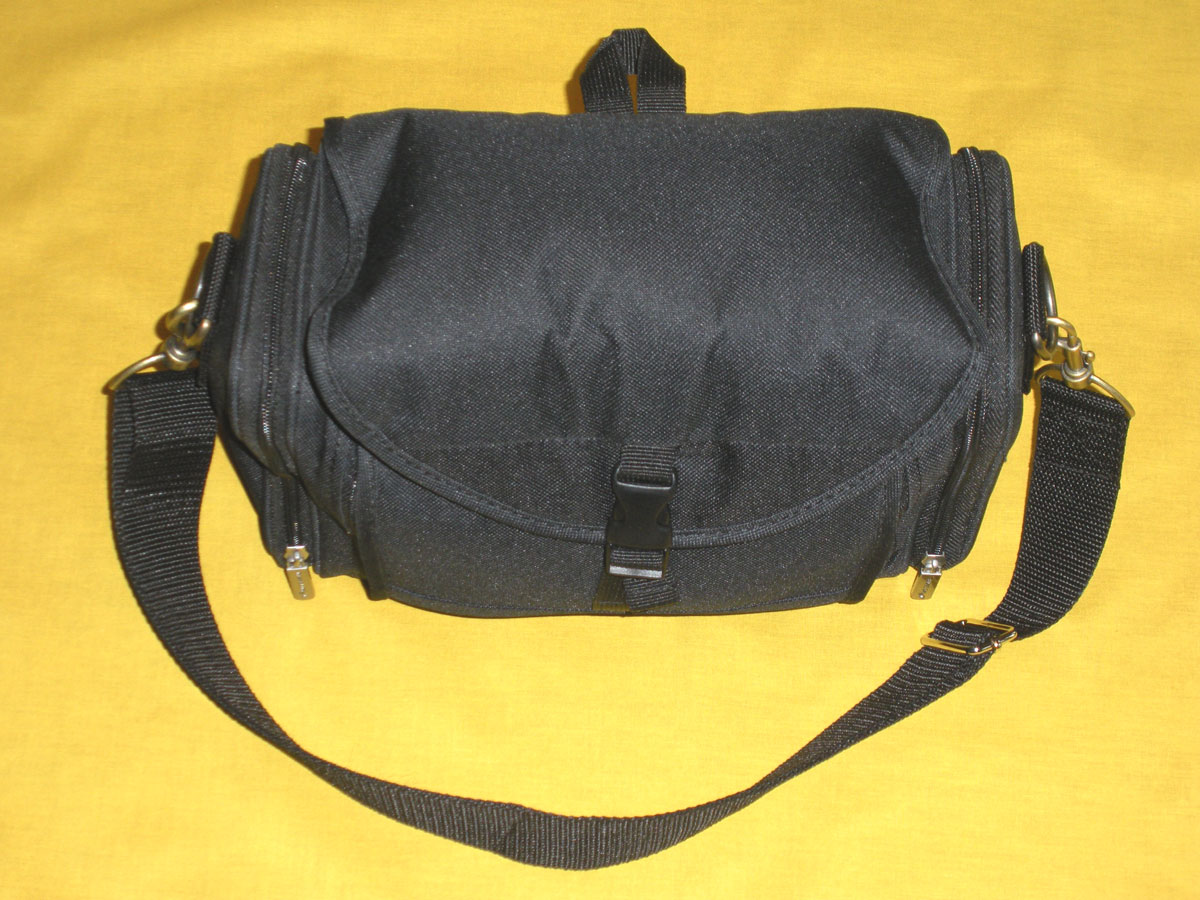
all contained in a modified and re-purposed Travelon ballistic nylon bag
with two zippered outside pockets, a mesh pocket inside the top flap,
interior zippered mesh pockets and a main cargo compartment. We've had
George's Hockey Repair in Saint Paul add heavy stitched strap mounts and
and an adjustable carrying strap. Here are the things in it: Left pocket--Bandages and related materials.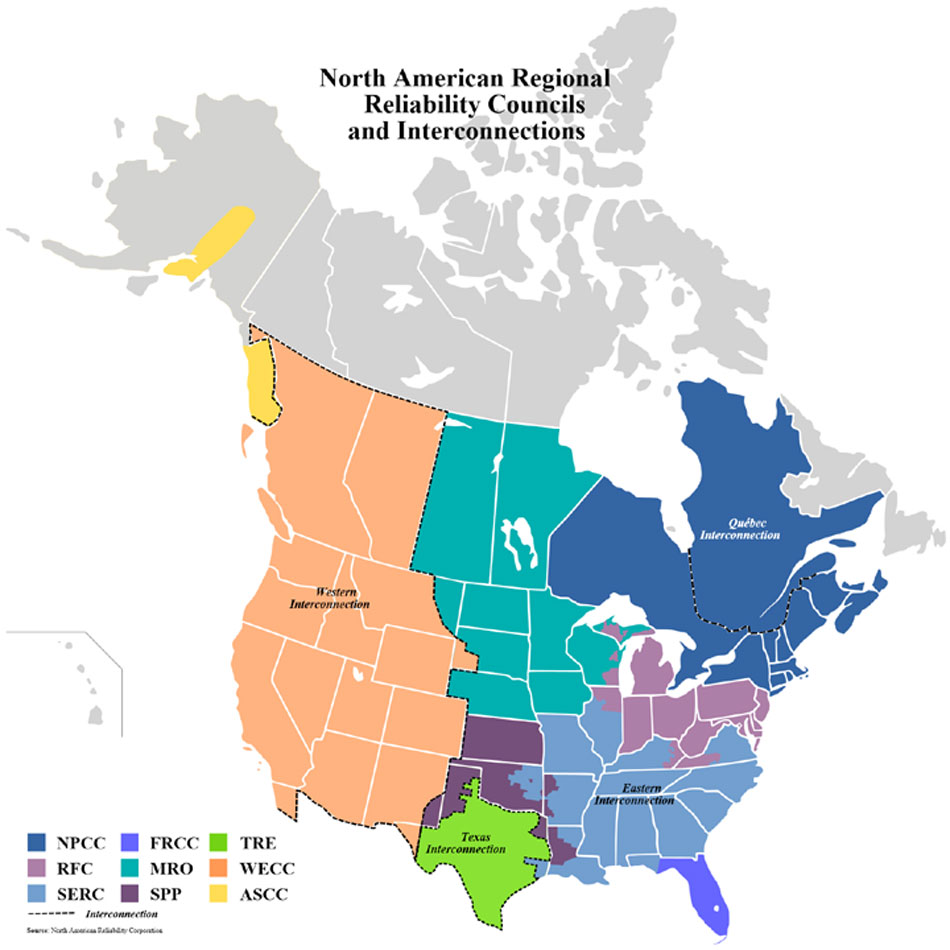
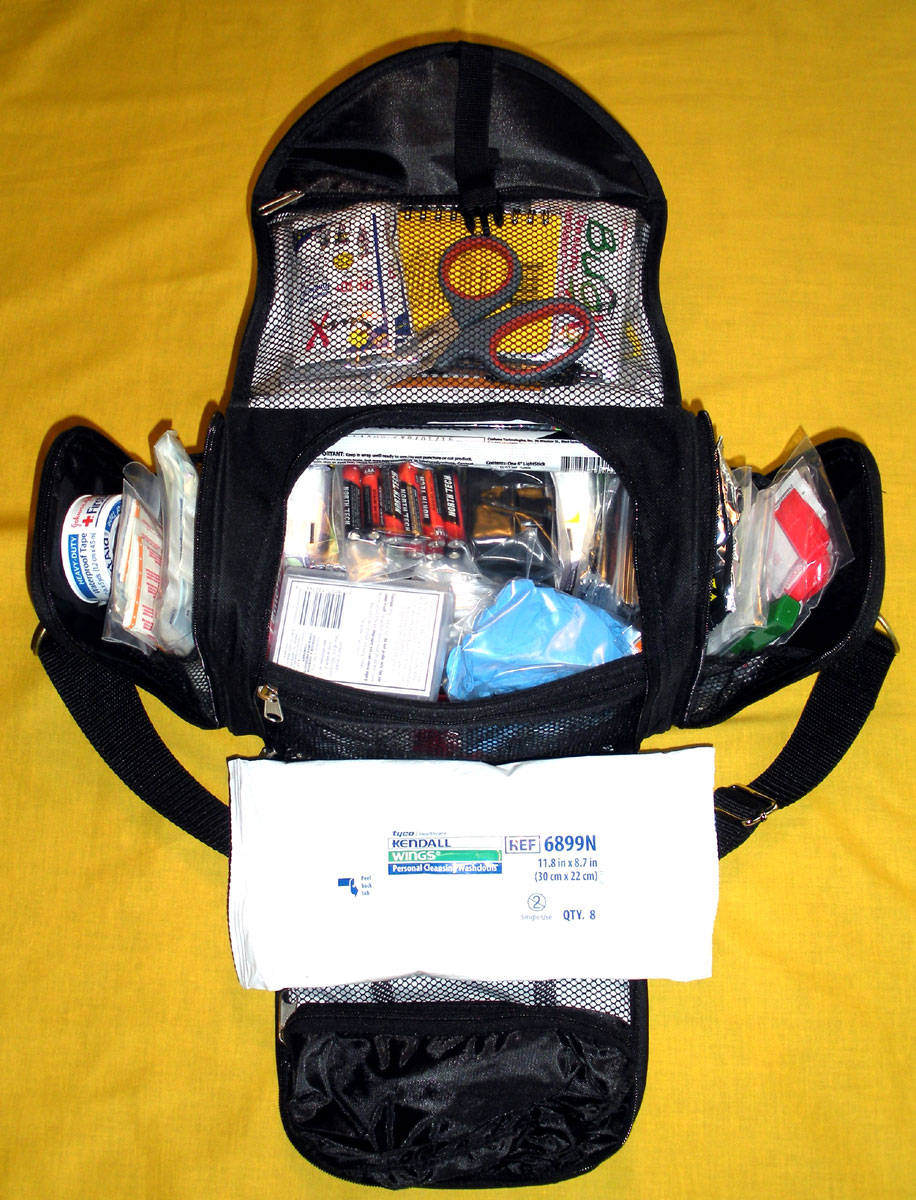
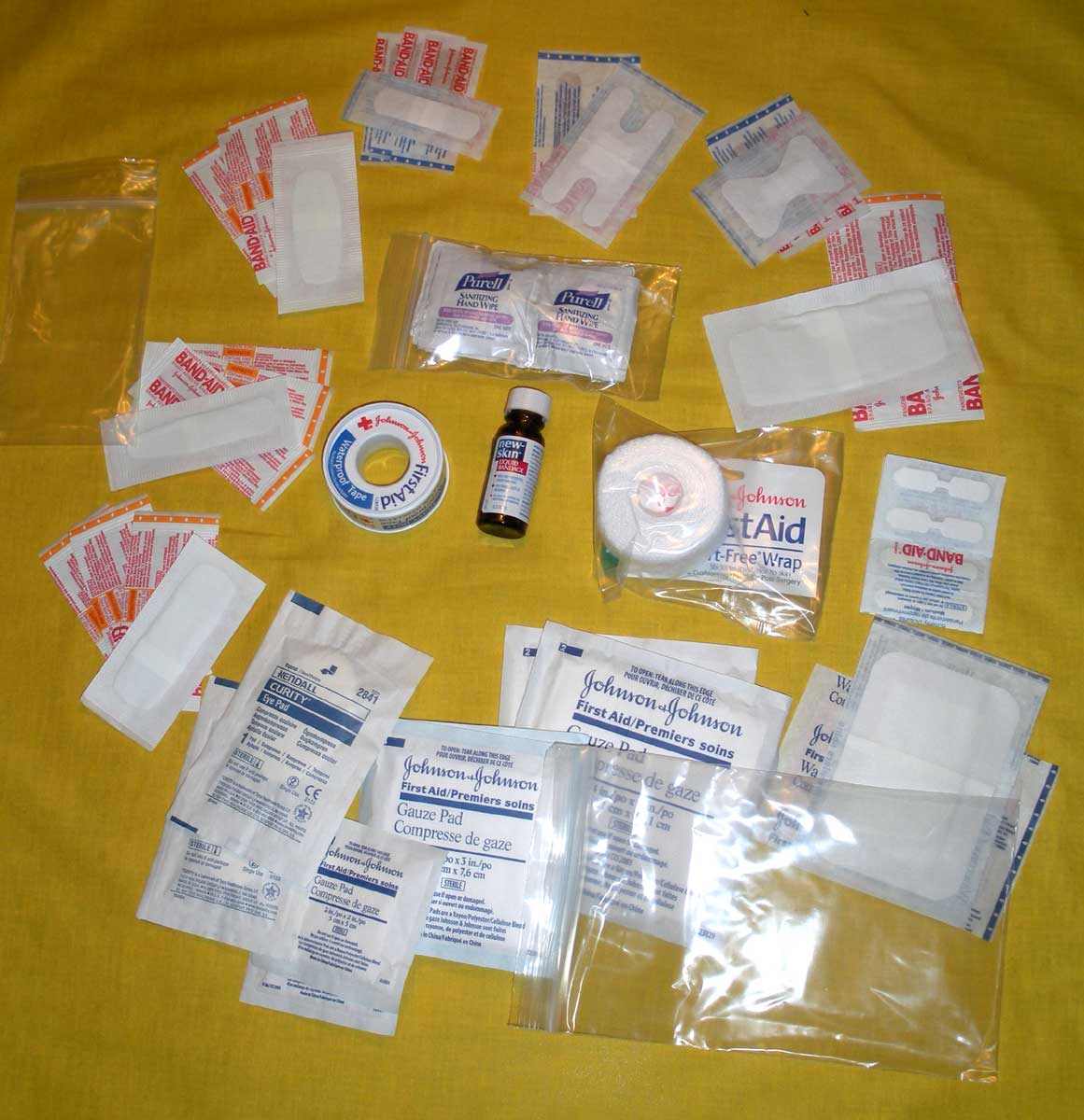
The left outside pocket is for quick access to bandaging materials. It contains:
10 large (approximately 5" x 7") Purell Sanitizing Hand Wipes. (We really like the large size of these towellettes, containing 62% methyl alcohol. Personally, we'd use these to clean up our own hands, thermometer or instruments, and the BDK for clean up around our own or others' scrapes, cuts and abrasions, but you will want to do your own research. We're not medics or doctors.)
4 Johnson & Johnson Antibiotic pad 1 x 3 inch bandaids.
4 Johnson & Johnson Antibiotic pad 3/4 x 3 inch bandaids.
4 Johnson & Johnson Antibiotic pad 1 x 2.5 inch bandaids
4 Johnson & Johnson 1/2 x 2.5 inch adhesive bandages (for little fingers)
2 Johnson & Johnson Heavy Duty 1 3/4 x 4 inch Antibiotic Bandage
3 Johnson & Johnson 3 x 4 inch Adhesive Pads
2 Johnson & Johnson knuckle bandages
2 Johnson & Johnson fingertip bandages
10 Johnson & Johnson butterfly closures (adhesive stitching)1 roll of Johnson & Johnson Hurt-Free Wrap (1/2 " x 2.5 yards). (This is useful for securing dressings and will stick to itself but not to skin or hair. It leaves no residue and is latex-free.)
1 roll of Johnson & Johnson Waterproof First-Aid (Adhesive) Tape (1/2 " x 5 yards). (For all uses where the Hurt-Free Wrap is not more appropriate.)
It would be possible to save a little money, right here at the outset, by including more "generic" bandaging materials. But sometimes you actually have to call on your insurance policy. Similarly, you can't lose sight of the fact that you might really have to use this bag for its intended purpose. By adopting the Johnson & Johnson products, for instance, you can always look through the back to see what size or shape the bandage is, and that's not always true of the cheap stuff. The same kind of logic applies to the use of antibiotics in the bandage padding. If push comes to shove and you're actually going to have to deploy this bag, there's a high likelihood that the conditions you or someone else will experience before and after the bandaging will be just plain filthy. And that's not the point where you should have to contemplate the notion of "false economy."
Right pocket--Things needed for quick response to predictable situations and some tools.
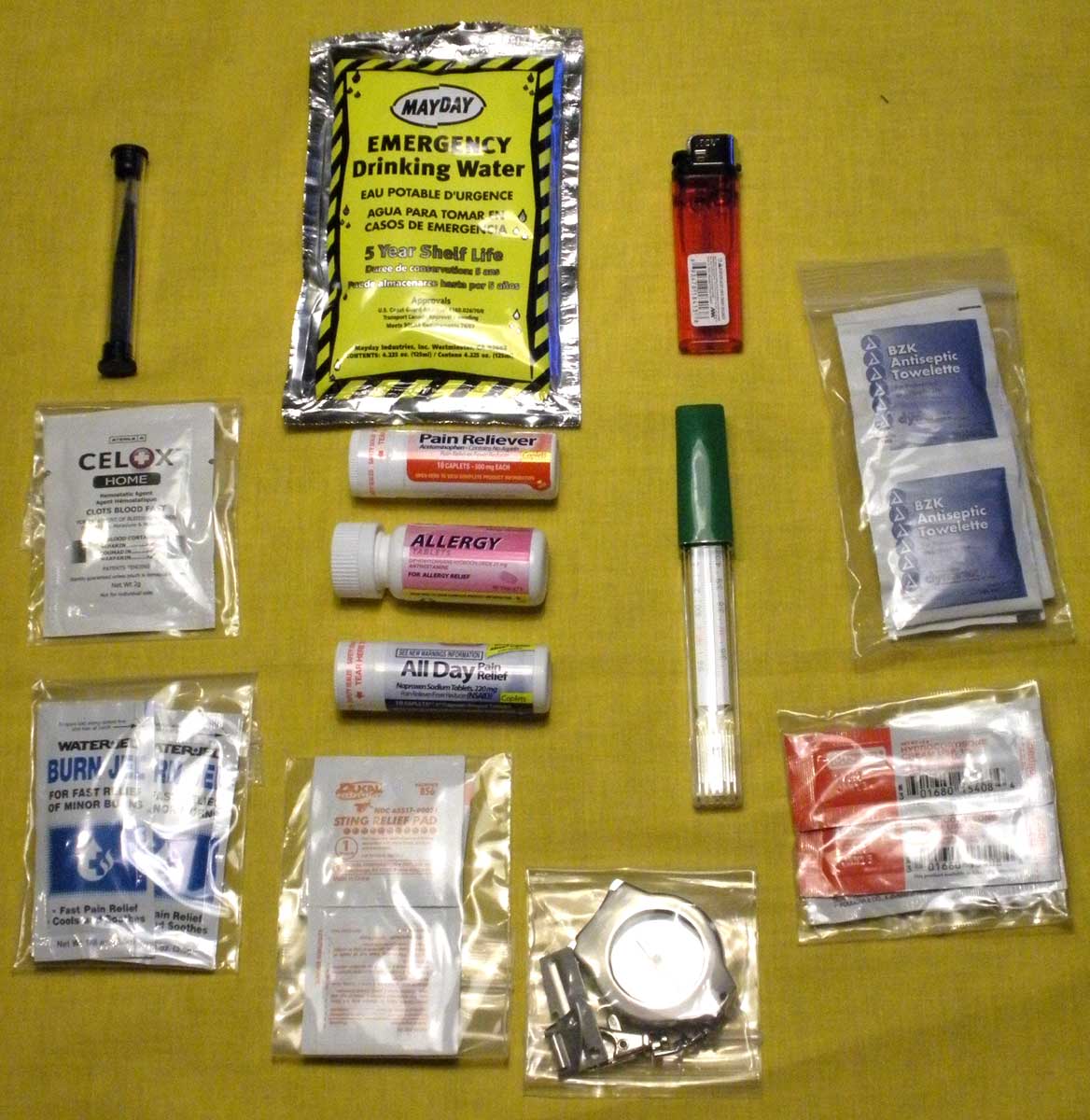
The right outside pocket is the "distress center" for quick access to items to deal with commonly anticipated situations in the field. It contains analgesics, ointments and some useful tools, including:
does.)10 large (approximately 4" x 7.5") BZK antiseptic towellettes. (Users may be more familiar with the familiar isopropyl alcohol swab that is about 1 inch square. We like the much larger size of these, given the possible geography of use. They contain Benzalkonium Chloride, the active ingredient in Bactine and high level disinfectants, and do not burn when placed on a wound like alcohol
Two sealed packets of two grams each of Celox hemostatic (clotting) agent for lacerations, cuts and abrasions.
One sealed tube of acetaminophen (compare to Tylenol)--10 each, 500 mg. (Lot number and expiration date on each tube.)
One sealed tube of naproxen sodium (compare to Aleve)--10 each, 220 mg. (Lot number and expiration date on each tube.)
One sealed tube of diphenhydramine (compare to Benadryl)--10 each, 25 mg. (Lot number and expiration date on each tube.)Five sealed pads of Dukal Sting Relief (contains 6% benzocaine topical anaesthetic and 60% isopropyl alcohol). (Lot number and expiration date on each packet.)
Ten sealed packets of Fougera Hydrocortisone Anti-itch Cream (contains 1% hydrocortisone cream USP). (Lot number and expiration date on each packet.)
Five sealed packets of Watergel Burn Relief ointment (contains 2% lidocaine HCL). (Lot number and expiration date on each packet.)
One pair splinter tweezers contained in reusable tube.
(You might be surprised just how easy it is to lose track of direction if you are walking through an urban neighborhood you normally bypass on the interstate or just drive through.)
One small folding outdoor survival compass with needle lock, fully rotating bezel with 5 degree marked increments, mirror and safety locking metal lanyard.
One Shelby Company "US" stamped folding P-38 can opener with pre-drilled hole for key chain, dog-tag chain, lanyard, etc. (This is the Vietnam Era C-Rat can opener of many uses, including screwdriver and utility knife. Some of us have had one on our key chain ever since back then, and would not do anything like these scenarios without one.)One Mayday 4.225 ounce drinking water sealed packet (five year shelf life--approved by US Coast Guard and others).
One mercury-free analog thermometer--does not use battery. (This instrument takes a little longer to get a reading, but it always seems to get the same reading, and you won't need to worry about battery life.)
Upper and lower interior pockets--Things to support the quick response items. Ointments, disinfectants, sterilization materials, etc.
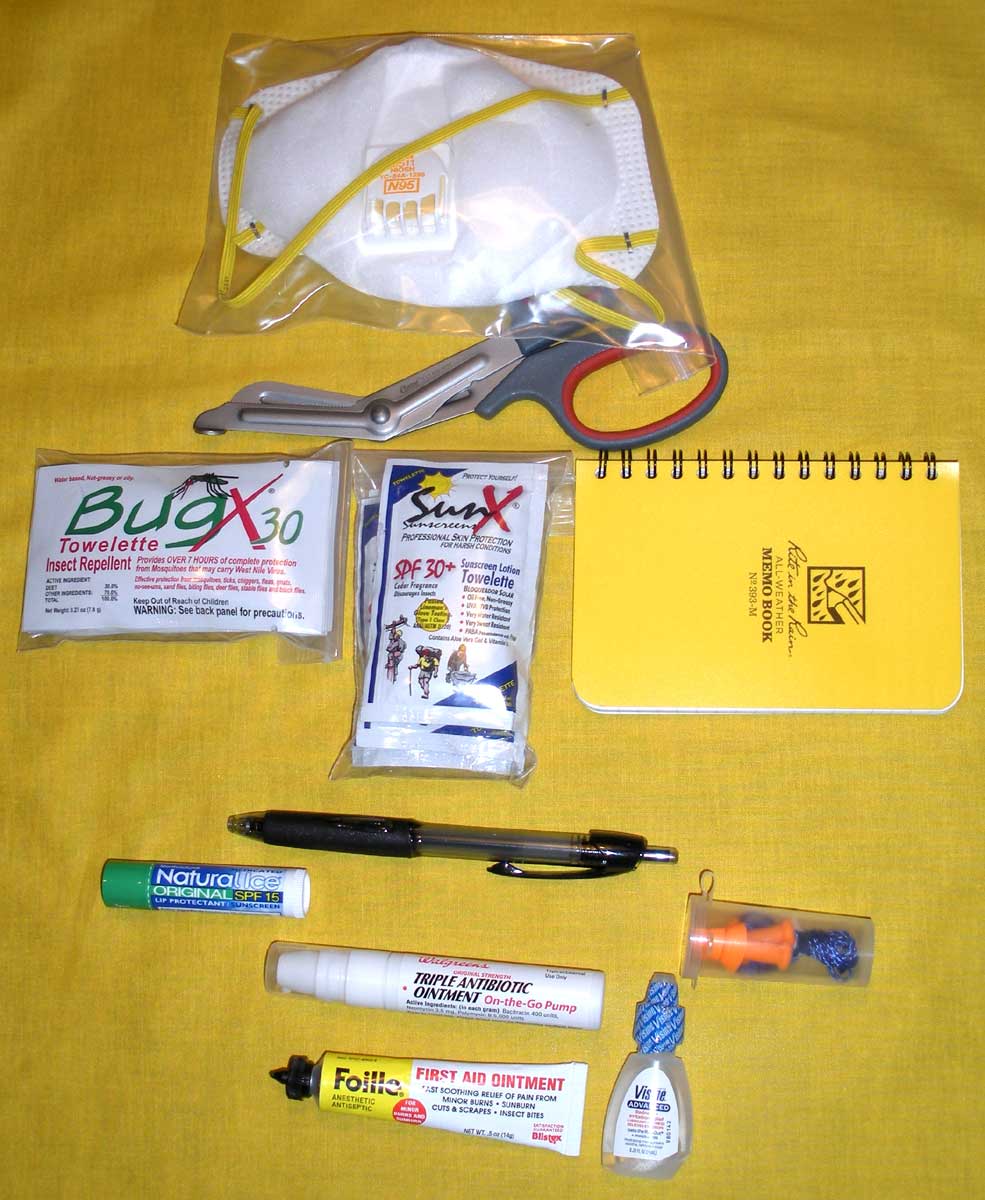
(N95 approval does not mean mask will protect you from all substances and concentrations. User will want to check 3M website for use recommendations and limits.)The top pocket is accessible without exposing the main cargo compartment of the bag. It contains items to supplement the materials in the two exterior pockets such as:
One pair of Clauss 7" Titanium medical shears for cutting away clothing, etc. Also useful for opening emergency water pouches, food bars and other items in the kit.
One 3M Tekk 8511 Particulate Respirator with Cool Flow Valve. N95 approved.
Five large (5" x 8") water-based insect repellant
towelletes containing 30% DEET. Effective against mosquitoes and other insect
pests for over seven hours.
Five large (5" x 8") oil-free, non-greasy Sun X SPF 30 suncreen lotion
towellettes. Will retain SPF rating after 80 minutes of activity.
One Rite-in-the-rain all-weather memo book. (J.
L. Darling Corp. #393-M)
One Uni "Power Tank" Space-type pen. (Writes
upside-down, sideways, in orbit, etc.)
The inner flap pockets contain items such as additional ointments, lotions and tools to supplement the things found in the exterior pockets:
One tube (.5 oz) of Foille anesthetic and antiseptic first aid ointment. Contains 5% benzocaine and .1% chloroxylenol, plus benzl alcohol. (For over 50 years Foille has been the Northern Plains answer to the kinds of burns you experience on the farms, ranches, kitchens and garages in the area. It is no longer called a "burn" ointment, but it still works as well and no kit like this would feel quite complete without it.)
One tube (.26 oz) triple antibiotic ointment in a pump spray dispenser. Contains 400 units Bacitracin, 3.5 mg Neomycin and 5,000 units of Polymysin B. This allows you to apply an antiseptic ointment where the injury has occurred to a child who might be fearful of physical touching of the wound, for example. (Lot number and expiration date on each tube.)One tube (.16 oz.) Mentholatum medicated Natural Ice Lip Protectant/ 15 SPF sunscreen. Contains Dimethecone 1%, Octinoxate 7.5% and Octisalate 5% plus inactive ingredients.
One vial (.28 oz.) Vizene. (Lot number and expiration date on each vial.)One pair Stanley conformable earplugs with 26" rugged retention cord and reusable plastic container with retaining loop. Noise Reduction Rating is 25 decibels. (Yes, that Stanley--the tool people. We get these through a local lumber yard.)
Main cargo pocket--All kinds of contingency items, including some that you might want to move into the pack for items like walking shoes, etc. that are too big for the aid bag.
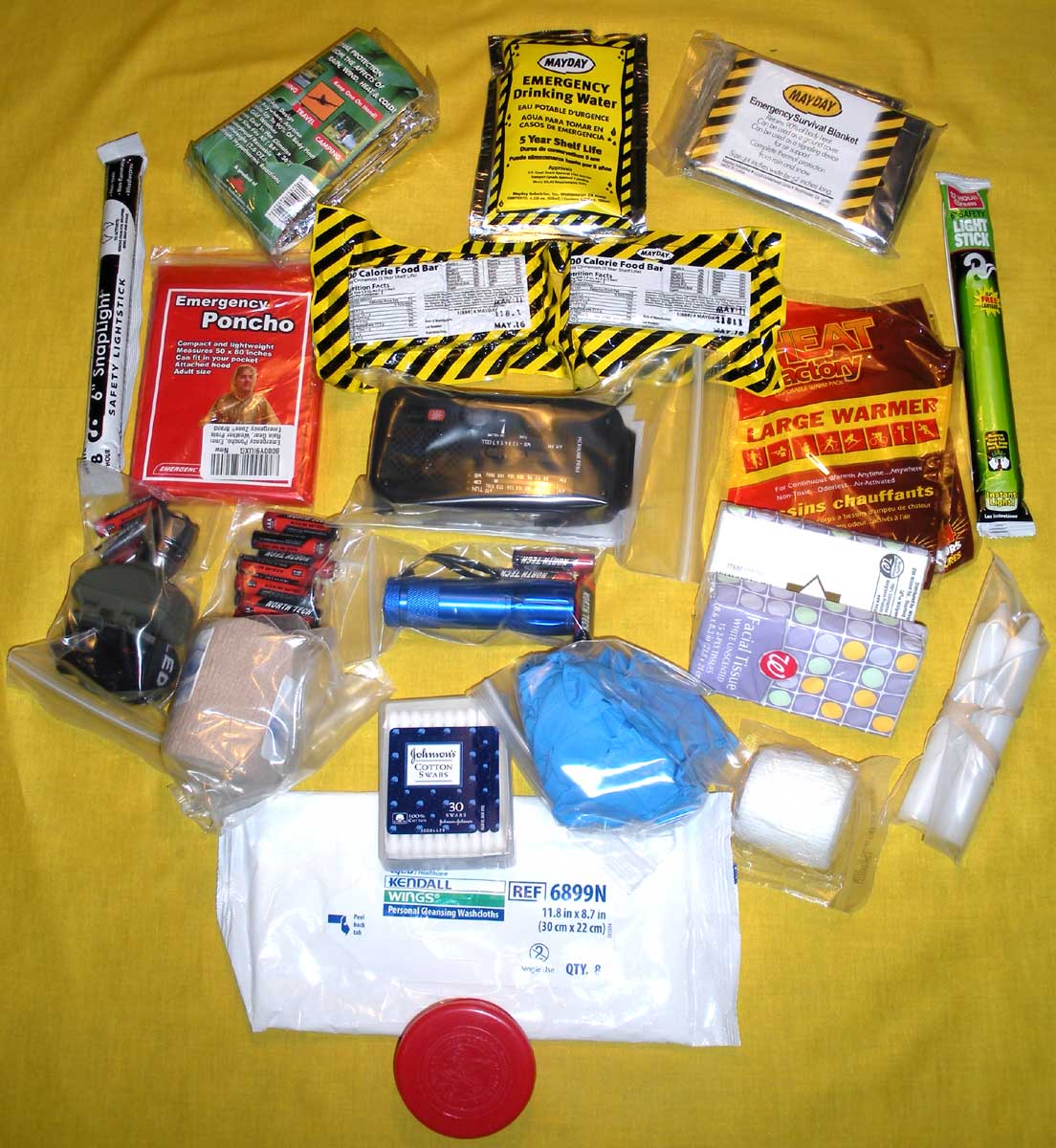
The items here have been chosen and sourced based on the kinds of scenarios which could occur on an overnight hike between work and home across terrain that may have been impacted by natural disaster and under conditions that could have been altered by interference with utility systems including the electrical web.
Two Mayday apple cinnamon concentrate food bars--400 calories each. These comprise the nutritional requirements for about 16 hours, and have a five year shelf life. They also taste better than some similar products.
One Mayday 4.225 ounce drinking water sealed packet (five year shelf life--approved by US Coast Guard and others).One lightweight 50" x 80" Emergency Poncho with hood.
One 84" x 36" Emergency Sleeping Bag with reinforced seams.
Two 84" x 52" Emergency Solar (space) Mylar blankets.
Two large (3.5" x 5") Heat Factory disposable 20+ hour warm packsOne six-inch, 12-hour green light stick.
One Cyalume six-inch 8-hour white light stick.
One 9 LED, three cell four inch flashlight with lanyard and batteries.
One Cree three cell zoom headlamp with three operating modes, includes headstraps and batteries.
Two five-inch survival candles.
Nine spare AAA batteries in waterproof wrap.One Eton Microlink FR160 Self-powered AM/FM/NOAA Weather Radio with Flashlight, Solar Power and Cell Phone Charger. (We love this thing. It blows the socks off similar products costing two and three times as much. Note: we do not include the USB to MP3 player/cell phone charging cord. These cords are individual to the device so you will have to get it from your device vendor or you could just cook your stuff.)
Two fifteen tissue packets of tissue.
One plastic pack of 30 cotton swabs.One sealed pack of rolled gauze--2" x 2.5 yards, self-securing.
One roll of 2" x 5.5 yard Leader self-grip athletic bandage.
Five pairs of Natrile glovesOne reclosable pack of eight Kendall Wings Personal Cleansing Washcloths, large size (11.8 x 8.7").
One Boy Scouts of America official imprint folding red cup. No, seriously...
That's about 6 pounds of that insurance you truly hope you will never need. As we begin to make these available to the public, there may be some variances in color or sourcing of some items, but this is pretty much the mix we have settled on.
The GMH Bag is being offered for $199.95, and is listed on E-Bay. Just sign in to E-Bay and search for item number 330691651884 or for "Get Me Home Bag."
In future chapters of this analysis, we'll take a look at that second bag in the Get Me Home Kit, the mobility portion of it. We'll also be looking at what we found about preparing to support six people for three plus days at both a fixed location and in the event of an evacuation, plus a way to cut down on gasoline expenses in the short run and be better prepared to evacuate in the event. The good news is that MREs are a whole lot better tasting than they used to be. The bad news is that as of mid-July, 2011, the Pentagon announced one of its largest losses ever of sensitive data in a cyberattack by a foreign government... And in September, one worker in Yuma, Arizona accidently knocked out electrical power to as many as six million people in two states and two countries for up to 12 hours. When you go back and read the details of that first big northeast blackout back in 1977, it's not good news...
September, 2011
For those of you who are new to these pages, The Northern Plains Archive Project is a history and culture preservation activity that includes a research and prototyping function. This web site was established in 1999, during the last millenium. For over a year the Project has been working to assemble and deploy a realistic method and equipment set to conform with its own natural and man-made disaster estimates. The Get Me Home Bag is the first of several product assemblies to be fielded.