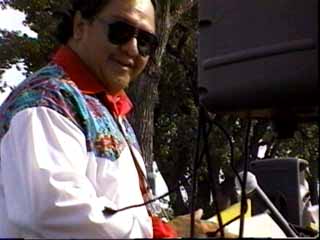
Complete Text of Chief Dennis Pashe's Prepared Remarks
at the Harriet Island Rededication
September 9, 2000
Mayor Coleman—Ladies and gentlemen—Shungi.
It is a good day to be in Kaposia.
Some of you may be wondering what a guy from Canada is doing speaking here today, and I will tell you. Like many things, it has to do with water and earth.
I would like you to picture two drops of rain falling from a cloud over western Minnesota, between Lake Traverse and Big Stone Lake. They fall —an inch apart— along the earth on the Continental Divide, out there near Brown’s Valley.
One drop falls to the south and flows with the waters that become the Minnesota River. It runs past the Dakota bands at Granite Falls and Morton, and north past the ancestral villages near Shakopee. That raindrop joins with the Mississippi right over here to the west. It flows past this island and then swings south to run past the Dakota people living at Prairie Island, on its way to the Gulf of Mexico.
The other raindrop falls, an inch away, to the north of that divide and it runs north past the Dakota people in North and South Dakota. It runs with the Red River into Canada, and joins with the Assiniboin River. If you follow the trace of those waters, you will find the Dakota people living in Canada, including my people at Dakota Tipi First Nation, on the banks of the Assiniboin River.
200 years ago and more, my ancestors lived along these waters behind us. Their village was called We-ya-ka O-ti, and it was located just west and south of Shakopee, at a place called Sand Creek. You now call that area Louisville Swamp Wildlife Refuge.
The name of their chief was Mazomani (Iron Walker). You have a trail along the Minnesota River that is named for him. His chief soldier—you would say "warrior"—was my great-great-great grandfather, whose name was Yajopi .
In 1851, Mazomani and Grandfather Yajopi signed a treaty with the United States government, and my ancestral band started on the trail that would lead through hard times and war to the place where we live now. By 1875, Yajopi’s son, my great-great-grandfather, was the headman, or chief, of Dakota Tipi band in Canada, and this responsibility has passed down through my father’s line to me.
I tell you these things so you can understand that this land we stand on, and that land behind us with all the office towers, and sports arenas and government buildings, and the land that surrounds us all the way up into Canada felt the footsteps of my ancestors and other Dakota people. It heard their dreams and prayers for a good life, good health, brother and sisterhood. I am told that this island was a place for peaceful trade and meeting—perhaps even celebration.
Some will tell you that dreams and prayers fade, but I will tell you that they do not die. My children are here today, so I stand with seven generations of my family, from great-great-great grandfather Yajopi to Colton and Micayla. I carry the dreams and prayers of all my ancestors who walked and lived beside these old waters that flow behind me. It is good to be back.
Now I will tell you a story from your history that you may not know.
We all know that war came between native people and the government here in Minnesota about 135 years ago. As the winter of 1862 arrived, there were eight white women and children that had been taken captive in western Minnesota. They were being held far to the north and west, near the Grand River in what is now North and South Dakota. Many miles to the south of them, near what is now Pierre, a small group of Dakota warriors, what we would call "brother-friends," were shown in a good way that these white people should be returned to their own.
These eleven young men rode off by themselves into that wide country where thousands were at war. They entered a camp where they were unknown and outnumbered more than 10 to 1. They traded away all of their horses, their personal possessions, their weapons and food—everything they owned—for the lives of these captives. And in a very bad time for a few Dakota men to be in the company of white women and children, they began walking straight for a column of cavalry riding hard from the south.
They would be given a name—they were called "Fool Soldiers."
They gave their moccasins and blankets to those they had freed and walked through a November blizzard with their feet wrapped in rags. When they returned to their camp safely, the wives of these young warriors nursed and clothed those who had been held. They escorted these eight Minnesota women and children to Primeau’s post at Fort LaFramboix, near present day Fort Pierre. And then the Fool Soldiers walked away, empty-handed.
It would take almost 50 years for their deeds to be recognized, with a small marker near Mobridge, South Dakota.
But they had not done these things for gain or recognition. They had believed it was the right thing to do—and acted fearlessly upon that belief.
That was about 135 years ago. But I don’t want you to think that the spirit of the Fool Soldiers is gone with those times. You can still find it, and you don’t even have to look very hard, but you have to look in the right places.
You have to remember that these were just plain people. They weren’t wealthy or important, but they were willing to do the right thing, regardless of what it cost them. And the spirit of the Fool Soldiers still lives among the people, people of all races, who struggle to make it in this world, and in the children.
You don’t have to be young or poor to be a Fool Soldier. Almost everyone comes from people who were poor at one time, and each of us still carries the pure heart of a child within.
And that is the other place to look—in the heart.
So when the City of Saint Paul came to some of my friends and said that they wished to rededicate this island in a way respectful of the ancestors, they listened. When they were told that people from the city wanted to participate, not just observe, they listened even harder. And when your city said that you wished to build a special place on this island, for people to find peace in the way of native people, they listened very hard.
We have words for such a place—we call it Oyanke Wahbada. There aren’t very many of these places. They are a gift from the creator, places where peace is found, the heart is lifted, and the soul is refreshed. They are places where you experience stillness and awe. This place could not just be built. It would have to be created, with the help and blessing of the Greatest Creator. It would have to be woven from vision and prayers, sweat and dreams, and a coming-together of people to ask that it be blessed in its making and keeping.
My friends talked to elders from the Prairie Island Community and the Yellow Medicine Community. They talked to medicine people from this country and from Canada, and with sundancers and pipe carriers from the Dakota people. They spoke to me and to others in leadership positions. They looked to the hearts of those who had asked for these things. And they began.
For four months there have been words said, in very old ways, for help and guidance to have these things happen in a good way. During the last four weeks, ceremonies have been held here on the island, seeking a vision of a better way of life. And last night, people entered this special place for the fourth time to ask together that a way be shown to good health and happiness and a good life for all of the people of this city
People from every race, and every walk of life, have been there and joined their words together.
All of these things were given, because it was the right thing to do, and because you asked to learn and experience these old ways of my ancestors. It was done because—as my relative Shungi said—we are all related.
I am told that the City of Saint Paul is committed to completing this Oyanke Wahbada, (this special safe and peaceful place), here on the island. You have asked to learn about the wisdom of the first people when choosing the plants and creating it.
I will help the city in your work to make this place—this Oyanke Wahbada—here on Harriet Island, and I will speak to others, so that there can be a place in the heart of Saint Paul dedicated to the relatedness of all, and to the truth of the heart. The plants and soil of all the far reaches of the Dakota people can be brought here to help in these things.
I will only ask this. As this work goes forward, through the meetings and planning and funding requests, remember how it was started. Remember the words and sacrifices that you will be building on. Remember that the creator must be woven into the making.
When things get hard, remember the Fool Soldiers, and do the right thing, the thing that is in your heart.
I have something to help you remember. Mayor Coleman and I have discussed the symbolism of this star quilt. Mayor, I ask you to keep it for these next four years, to remember that the whole story should be told, to remember the lesson of the Fool Soldiers, and to remember that we are all related to each other, the earth, the water and the plants and creatures who live with us
There is another word in my language—"pidama." Some people say that it means "Thank You," but it can also be translated into the English language as "You have made me feel very good."
Pidama.